 中文
中文FAIST Voices: How Portugal’s Carité Is Betting on Automation to Secure the Future of Shoemaking
For four decades, the name Carité has been quietly stitched into the fabric of Portugal’s footwear heartland. Based in Felgueiras — the northern cluster that supplies many of the world’s most demanding shoe brands — the company began in 1986 as a one-man sewing operation and has grown into a full-scale manufacturer exporting practically its entire output. Today, as price pressure intensifies across European manufacturing, Carité is placing a different kind of bet: that automation, not retreat, is the only durable answer.
The story was laid out in the latest edition of FAIST Voices, the spotlight series from the FAIST consortium (Agile, Intelligent, Sustainable and Technological Factory). FAIST is a multi-partner initiative uniting more than 40 actors across manufacturing, technology and research, running from June 2022 to June 2026 with roughly €50 million of investment. Its stated ambition is to drag the footwear and leather goods sector into a more digital, efficient and competitive era. Carité is one of its most active testing grounds.
Reinaldo Teixeira, manager at Carité, recalls the company’s modest origins. “We started with a reduced workforce,” he says, building early growth on “the quality of the service provided” for the leading factories of Felgueiras. The business was formally established in May 1990, and in 1994 it took a decisive step — moving from sewing services into complete footwear through its own product development. From there, Carité focused on “high-quality footwear” with “an aggressive commercial attitude,” steadily deepening its presence in international markets.
Since 1995, Carité has exported virtually all of its production, working mainly for major international brands that buy footwear under their own labels. That positioning — a Portuguese manufacturer serving exacting external clients — is both its strength and its vulnerability. The vulnerability is simple: brands producing in Portugal are increasingly fixated on cost, while factories face expenses that climb “every month and during the year.” Teixeira is blunt that traditional labour alone cannot absorb that gap.
This is where FAIST matters. For Carité, the project is part of a wider shift toward automation, robotisation and smarter production lines. Teixeira argues that Portuguese manufacturers must “mechanise” and move toward “more automatic, more intelligent, robotised lines” — not to chase volume, but to reach medium-high and top-tier brands with products of greater added value. The logic is that higher-value footwear justifies better pay. In his view, automation can help companies “produce better-paid footwear” and, in turn, “pay workers more” and attract younger generations who might otherwise drift to other industries.
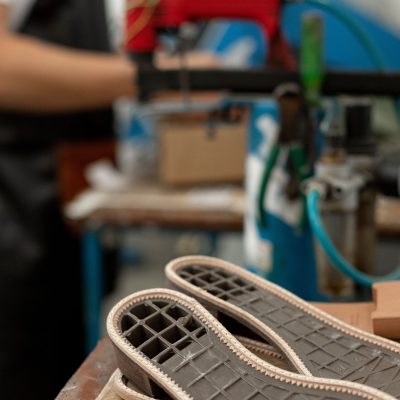
On the factory floor, Carité is validating a remarkably broad portfolio of technologies. With the University of Aveiro it is developing multifunctional bioplastic coatings for sustainable performance finishes on insoles and uppers, and researching 3D-printed footwear lasts that could replace heavy, costly traditional resin lasts in early development. With Tecmacal it is testing equipment for a water-based polymer immersion process that forms soles to a precise height. Centimfe’s artificial-vision system inspects cutting tools — geometry, picks, scribers, ejectors — to tighten tooling quality. DCSI Pro’s High Frequency Fusion Cell validates advanced upper fusion through sequential heat pressing, cold stabilisation and high-frequency moulding, while its Integrated Line for Multiproduct combines conveyors, injection machines, RFID pallets and robotic-ready stations for traceable, adaptable workflows.
On the digital side, Olifel’s Visualgest modules manage planning, shipping, samples and RFID tracking using AI and real-time data, and a Document Integration module exchanges CIUS-PT standard documents to cut documentation errors. SADIC, built with Expandindustria and INESC TEC, evaluates performance from the eCODICEC process app and digital twins on the factory floor.
The throughline is clear: Carité wants to keep producing traditional footwear well while building “a different future” through automation, robotisation and better-qualified teams. For a sector squeezed between rising costs and unrelenting price pressure, that dual-track strategy — preserve craft, industrialise the rest — may be the most realistic survival plan on offer. If FAIST’s bets pay off, the winners will not be the cheapest factories, but the smartest ones.
Source: World Footwear — “FAIST Voices: meet Carité Shoemaking Group” (published Oct 5, 2026).