 中文
中文Robots on the Line: How a Century-Old Portuguese Shoemaker Is Automating the Future of Footwear
In a northern Portuguese factory that has been making shoes since 1927, four robots now rough, prime and glue uppers alongside human workers — and the company says it is only the beginning. Abílio P. Carneiro & Filhos S.A., a family-owned footwear manufacturer now run by its fourth generation, is a vivid case study in how traditional shoemaking is quietly being rebuilt around robotics.
The automation is happening under FAIST, the Agile, Intelligent, Sustainable and Technological Factory project. Running from June 2022 to June 2026, FAIST brought together more than 40 Portuguese partners across footwear, leather goods, technology providers and research centres, channelling roughly 50 million euros of investment into modernising the industry and sharpening its international competitiveness.
A family business built for the long run
Founded nearly a century ago, Abílio P. Carneiro & Filhos has weathered waves of growth and restructuring in the footwear sector. Since the 1980s it has built a strong export focus, reaching beyond traditional European markets, and operates primarily on a private-label model — handling everything from product development to logistics for its clients.
Its speciality is technical outdoor footwear, particularly waterproof products, where meeting exacting material and process requirements is the whole game. That precision-focus made it a natural fit for FAIST’s ambitions.
What the robots actually do
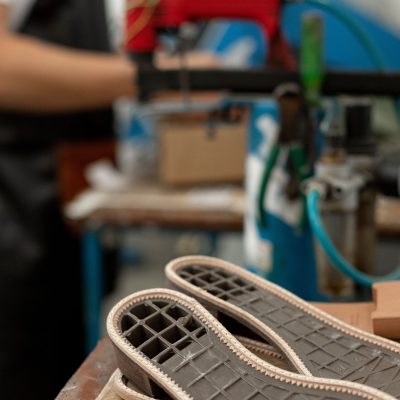
As part of the project, the company extended a nine-year collaboration with software firm Tropimática to build an automated production line: four robots, a dryer and a conveyor belt. The system automates four repetitive stages of assembly — roughing the sides of the uppers, roughing the underside, applying primer, and applying adhesive — the preparation steps before outsoles are glued.
CEO Alexandre Carneiro noted the work involved “overcoming several technical challenges,” especially adapting robotics to the “industrial problem” of small batch sizes and the huge variety of products and materials typical in footwear. That is the crux of shoemaking automation: mass customisation, not mass production.
The human payoff
The company says the line has already improved precision, quality and process consistency. Just as important, Carneiro argues that “automating repetitive operations frees up operators to perform higher-value tasks and improves workplace ergonomics.” The goal is robust, flexible solutions that slot into the technical footwear line and accelerate digital transformation.
Why this matters
Portugal remains one of Europe’s footwear powerhouses, and its future competitiveness hinges on exactly this kind of upgrade — pairing craft heritage with smart manufacturing. If a century-old shoemaker can make robots a routine part of the line, the rest of the industry has a blueprint to follow.
Source: World Footwear — FAIST Voices: meet Abílio P. Carneiro & Filhos S.A (https://www.worldfootwear.com/news/faist-voices-meet-abilio-p-carneiro-filhos-sa/11735.html)