 中文
Argentina’s Tannery Takeover Is Now a Supreme Court Case — and a Warning to Investors
A tannery in Argentina has become a test of whether a provincial government can declare private industrial assets effectively forfeit, and a former owner is now asking the country’s highest court to put a price on it.
Gilmar Harth, former owner of Curtume CBR S.A., has filed a damages lawsuit against La Rioja province over the takeover of the company’s assets. The case has been registered with Argentina’s Supreme Court. The lawsuit seeks to hold the provincial government financially liable for the takeover of Curtume CBR’s facilities and other assets.
For anyone weighing tannery investment in emerging markets, the file is worth reading closely — not for the drama, but for what it says about how fast the rules can change beneath a plant.
How the dispute began
The story starts in late 2021. La Rioja passed a provincial law declaring the company’s land, facilities and production units to be of public utility and subject to urgent takeover. The move followed months of halted industrial activity and the withdrawal of operations.
That sequence is familiar in distressed industrial situations. A plant stops, workers lose income, the local economy around it degrades, and political pressure builds to do something. Declaring the facility “of public utility” is a legal instrument that allows expropriation on public-interest grounds — normally paired with compensation.
The question in dispute is whether that pairing actually happened.
The machinery notice
A few months ago, provincial authorities took another step in the takeover process, issuing a notice covering a number of vehicles and pieces of industrial machinery linked to Curtume CBR. The list included trucks, forklifts, loaders and other equipment. The notice gave the company and other parties claiming rights over the assets 10 working days to respond before the authorities proceeded with formal possession.
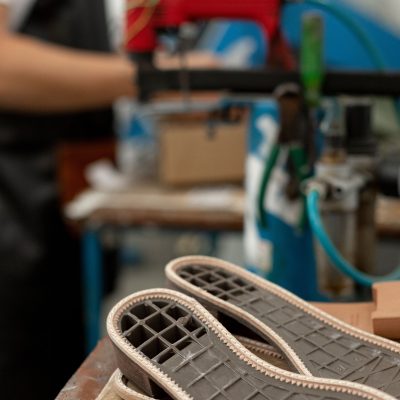
Industrial equipment is where tannery value actually concentrates. Drums, fleshing machines, splitting and shaving units, sammying and setting-out machines, spray lines, and the trucks and loaders that move hides — this is the recoverable capital of a leather operation. Once possession of that machinery transfers, restarting production becomes practically impossible even in theory.
The constitutional argument
Harth’s case rests on two claims: that the provincial government violated constitutional protections for private property, and that it failed to follow the required procedures for prior compensation.
Both are standard grounds in expropriation litigation, and they are where these cases are usually won or lost. Argentine constitutional doctrine, like most systems derived from civil law, permits expropriation for public utility but conditions it on prior compensation and due process. If a province takes possession of machinery before compensation is determined or paid, the procedural defect can be fatal to the taking.
The Supreme Court’s involvement elevates this beyond a local commercial dispute. A ruling will effectively clarify what a provincial public-utility declaration can and cannot accomplish when the owner contests it — which is precisely the sort of precedent that shapes investment risk assessments for years.
What it means for leather investors
Tanneries are immobile, capital-intensive and environmentally scrutinised. Those three characteristics make them structurally exposed to political risk in a way that trading businesses are not.
A tannery cannot be relocated when the regulatory or political climate turns. Its drums, pits and effluent plant are sunk capital tied to a specific site. It typically employs a concentrated local workforce, which makes it a political object. And because tanning carries environmental liabilities, governments have an additional justification for intervention that is harder to contest than pure economic policy.
Curtume CBR’s case is an unusually clear illustration of the sequence: operations halt, the state declares public utility, assets are inventoried and possessed, and the owner’s remedy becomes a damages claim measured years later. Even a fully successful lawsuit does not restore a business — it converts a productive asset into a receivable.
The practical lessons
For operators and lenders, three takeaways are worth carrying forward.
First, structure exposure to site-specific assets with political risk insurance or guarantee instruments where available. Tannery projects in provinces with weak fiscal positions and volatile politics are exactly the cases such cover exists for.
Second, keep asset registers and independent valuations current. In a takeover dispute, compensation is argued from documentation. Owners who cannot evidence the value of their machinery at the date of possession rarely recover what it was worth.
Third, treat a prolonged shutdown as a political event, not just an operational one. Curtume CBR’s takeover followed months of halted activity — the state’s intervention was preceded by the plant’s own distress. Preventing the stoppage is the primary mitigation; once a plant has stopped and the workforce is idle, the political clock starts running.
The wider Argentine picture
Argentina’s leather sector has struggled for years with currency instability, export taxes and competitiveness against Brazilian and Uruguayan rivals. Legal uncertainty of this kind compounds those problems, because the investors most needed — technical partners with capital for effluent plants and finishing lines — are also the most sensitive to property-rights questions.
The outcome and any potential financial consequences for La Rioja will depend on how the proceedings develop. But the case has already sent its signal: in this jurisdiction, a tannery’s assets can change hands first and be argued about later. That is a cost of capital no export incentive fully offsets.
Source: Leather News (leathernews.org)