 中文
中文17 brands, with a total revenue of RMB 1.24 trillion, are still growing. However, behind this growth, the landscape has completely changed.
Nike remains the top player, with Adidas in second place, but the gap is narrowing rapidly. More importantly, a group of brands that you might have considered “niche” just a few years ago are now aggressively taking a bite out of the giants’ market share糕。
Adidas is slightly better than Nike, maintaining its second place position, but its growth rate is also slow.
What’s truly alarming is the following set of data: On Running, with a growth rate exceeding 30%; Salomon, with a growth rate of 31%; Archery, with a growth rate of 30.1%; and HOKA, with a growth rate nearing 15%. These brands, which were just a few years ago labeled as “niche running shoes” and “exclusive to the outdoor community”, are now taking a bite out of Nike and Adidas’s market share at a rate of 30% annually.
There is also a long-established brand that is not listed – New Balance, which has maintained a 20% annual growth rate for four years and has already reached the threshold of 10 billion US dollars. What is the concept of 10 billion? It is on the same level as Adidas and Decathlon.
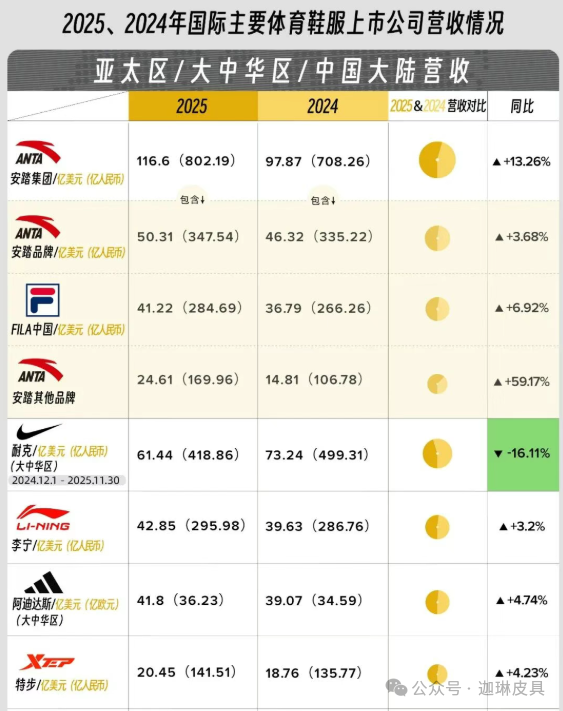
Anta Group (excluding Amer Sports), with its revenue exceeding $10 billion for the first time in 2025. When combined with the revenue of Amer Sports (the parent company of Archangel and Salomon) in Greater China, the total exceeds $13.5 billion.
What level is this? Globally, it has already surpassed all competitors except Adidas.
Even more impressively, the “other brands” under Anta, primarily Descente and Kelon, have seen a growth rate approaching 60%. Descente has become the third sub-brand of Anta Group to achieve a turnover exceeding 10 billion yuan, while Kelon’s growth rate is close to 70%.
FILA China also outperformed most of its peers, achieving a growth rate of 6.92%. Within the market segment of $3.5-5 billion, it performed quite well.
Chinese market: From “easy win” to “hand-to-hand combat” In 2025, the overall growth rate of China’s sports market was 8.37%, significantly better than the global rate (3.89%). However, compared to last year, it is also slowing down.
The most noticeable change is that the competitive zone has moved downwards.
Previously, it was Nike, Adidas, Anta, and Li-Ning competing for the top spot. Now, the $1-2 billion range is crowded with companies: lululemon China, Amer Sports Greater China, Anta’s other brands… Each is growing faster than the last.
Lululemon had been experiencing rapid growth in China, with a growth rate of 28.95% in 2025. While this may sound high, compared to previous years, its growth has actually slowed down.
On Running’s performance is even more impressive, with a growth rate of 96.5% in the Asia-Pacific region, which is 10 percentage points faster than last year. However, the brand itself has stated that it cannot maintain such a frenzied pace at this scale indefinitely.
Earning Potential: Who Is Swimming Naked?
Revenue is one thing, but making money is another.
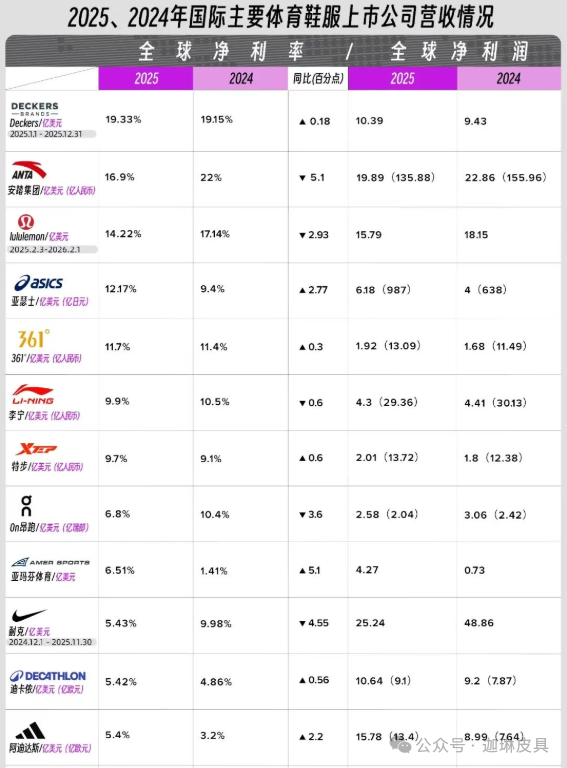
Only Deckers (the parent company of HOKA), Anta Group, and lululemon have a net profit margin exceeding 15%.
Although Anta Group’s net profit margin has declined from its peak last year, it still stands at a stable 16.9%. lululemon has also seen a decline, but its margin is still at 14.22%.
However, Puma and Under Armour are directly in a state of loss.
This indicates one thing: being large in scale does not necessarily equate to making money. Especially against the backdrop of global expansion, channel adjustments, and high inventory levels, the profits of many brands have been severely squeezed.
In the sports industry in 2025, there will be no new developments. Running and outdoor activities will remain the only main battlegrounds. Brands that are growing will mostly rely on these two fronts. Those that are not growing are mostly because they lack presence in these two areas.
In the era of stock competition, there is no such thing as “winning by doing nothing”. The cake you give up will be quickly taken by others.
The traditional leisure class is giving way to the sports class. Nowadays, status is an investment in oneself, and health is the new wealth.
But whether this is a universal truth is hard to say. The only certainty is that consumers have changed. Whoever can understand what they want faster will win in the next round.