 中文
中文title: “Birkenstock Lifts Full-Year Outlook as Demand for Premium Sandals Outpaces Capacity” seo_description: “Birkenstock raised its full-year 2026 revenue and profit guidance after a strong third quarter, with sandals, clogs and boots all outpacing capacity at its German factories.” seo_tags: [“Birkenstock”, “premium sandals”, “footwear demand”, “Germany”, “quarterly results”, “outlook”] seo_slug: “birkenstock-raises-fullyear-outlook-2026” source_url: “https://www.worldfootwear.com/news/birkenstock-raises-fullyear-outlook/11720.html”
Birkenstock Lifts Full-Year Outlook as Demand for Premium Sandals Outpaces Capacity
Birkenstock has rarely been a company to issue cheerful guidance. The German sandal maker has built its reputation on patience, on discipline and on telling the market what it expects to deliver rather than what it hopes to deliver. That makes the decision to lift full-year 2026 revenue and profit guidance, just a quarter after its IPO anniversary, a more significant signal than the numbers themselves.
The company said it now expects full-year revenue in a range of 2.05 to 2.10 billion euros, up from a prior range of 1.95 to 2.00 billion euros. Operating profit guidance was raised by a similar magnitude, with adjusted EBITDA margin expected to come in around the upper end of the previously communicated band. The market reaction was immediate: shares in the company, listed in New York, jumped more than eight per cent in pre-market trading as analysts rushed to revise their models. For a stock that has spent the better part of the last twelve months consolidating, the upgrade is the clearest sign yet that the Birkenstock brand is still in the early innings of its global expansion.
What is striking about the upgrade is that it does not come on the back of a single blockbuster product. The Boston clog, the Arizona sandal and the newer closed-toe silhouettes have all been selling well, but the company is not pinning its growth story on a hero SKU. Instead, management is talking about a structural shift in how consumers, particularly younger consumers in North America and Asia, view comfort footwear. Three years ago, the Birkenstock aesthetic was an acquired taste. Today, it is treated by major fashion houses and mass-market retailers alike as a category in its own right, with dedicated product lines, store-in-store concepts and capsule collections that have broadened the brand’s reach without diluting its positioning.
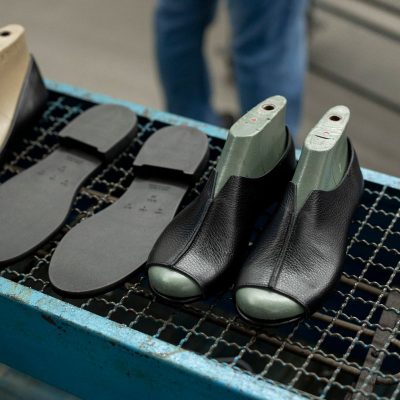
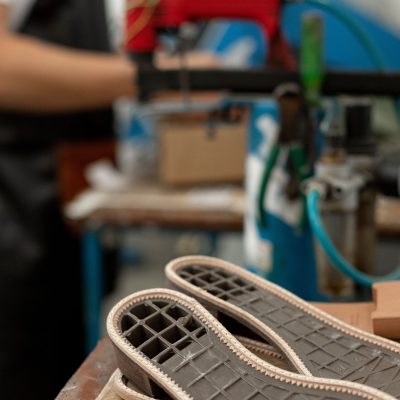
That broadening has put the company’s manufacturing footprint under unusual strain. Birkenstock’s German factories in Rhineland-Palatinate have been running at full capacity for several quarters, and the company has been investing heavily in a new site in Pasewalk, in the former East Germany, as well as in expanding its production in Portugal. The constraint is not demand — it is the number of pairs of cork-latex footbeds the company can physically produce in a week. A pair of Birkenstocks cannot be made without a footbed, and that single component has become the bottleneck of the entire business.
Management has been careful not to frame the capacity issue as a problem. In their view, selling everything you can make is the more comfortable position to be in than the alternative. The risk, of course, is that some of that demand migrates to look-alike competitors if a customer walks into a store and finds empty shelves three times in a row. To that end, the company has been deliberately pacing product allocation to its wholesale partners and is increasingly routing volume into its own retail channel, where the margin is higher and the brand experience is more controllable. Direct-to-consumer sales now account for roughly a third of total revenue and the contribution continues to rise.
Geographically, the United States remains by far the largest single market and the principal engine of growth. China and the rest of Asia, while still a relatively small share of total revenue, are growing at well above the corporate average. The company recently opened new flagships in Shanghai and Tokyo, and management has hinted at a more aggressive retail rollout in the second half of the decade. Europe, the spiritual home of the brand, is the slowest-growing region but also the most profitable, with stable sell-through and minimal discounting.
The broader question is how long the current cycle of premium comfort footwear can last. Some industry observers have started to use the word “bubble” in the same sentence as Birkenstock, a comparison the company itself rejects. Management argues that the brand’s price points, which sit well above the average for the category, reflect a real and durable change in consumer willingness to pay for comfort, longevity and repairability. They point to the company’s recently expanded repair service in Europe as evidence that the brand is being built for decades, not quarters.
For now, the numbers are on management’s side. The upgraded guidance implies high-teens revenue growth and a modest margin expansion in 2026, comfortably ahead of the global footwear industry average. If the company can convert the Pasewalk expansion into volume in time for the 2027 spring season, the next leg of the story may well be capacity-driven rather than demand-driven. In an industry that has spent the last two years worrying about excess inventory and weak consumer demand, that is an enviable position to be in.
Source: World Footwear (worldfootwear.com), reporting on Birkenstock’s Q3 2026 results and updated full-year guidance.