 中文
中文A regulation called the EU Deforestation Regulation (EUDR) aims to include leather in the scope of control for “deforestation products”.
What does it mean? That is to say, in the future, leather sold to Europe will have to be proven to be unrelated to deforestation.
Upon the release of the news, the global leather industry chain was in an uproar.
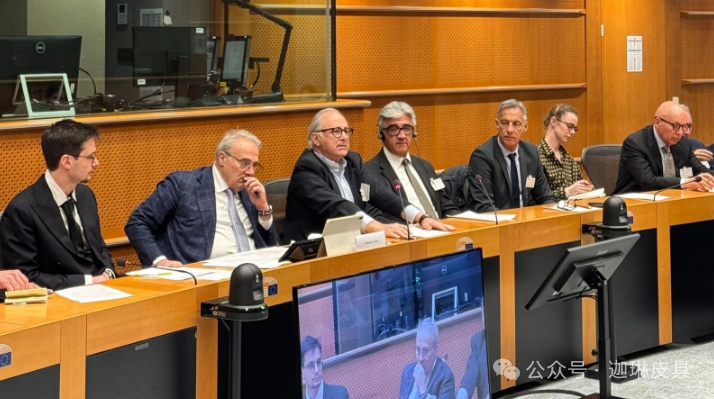
On April 8th, the European Parliament held a special meeting. Canada, the United States, Japan, Brazil… more than a dozen countries sent representatives. Everyone had one request: to remove leather from the list.
Many people, upon hearing “leather”, immediately think of cattle farming, which requires ranches, and ranches necessitate tree felling. Does it sound somewhat reasonable?
But when you do the math carefully, it’s not like that at all.
A piece of rawhide only accounts for about 1.4% of the economic value of a cow. The remaining 98.6% consists of beef, milk, internal organs, bones… Farmers raise cows to sell meat and milk. Leather is merely a by-product, or even a “waste”.
Have you ever seen someone cut down an entire forest just to sell 1.4% of the by-products? Only a fool would do that.
At the meeting, scientists presented data directly: leather is not the driving factor behind deforestation at all. It is soybeans, palm oil, beef, and other “main culprits” that truly lead to deforestation, not leather.
02 What are the consequences of forcibly wrapping leather?
The EU’s intention is good: to reduce global deforestation.
But if leather is also restricted, the result may be just the opposite.
Firstly, tanneries in Europe will flee. Europe already has limited cattle breeding, and most raw hides are imported from South America and Africa. If each hide were to be certified as “deforestation-free”, the cost would be extremely high and the process would be extremely complex. Small and medium-sized tanneries simply cannot afford it and would have to close down or relocate elsewhere.
Secondly, millions of hides will become garbage. If European tanneries don’t buy them, where will these raw hides go? Most likely, they will be thrown away, landfilled, or incinerated. A cow is only used for its meat and milk, but its hide is thrown away as garbage. This is completely contrary to the “circular economy” that the EU constantly advocates.
“Implementing the current plan will not only fail to curb deforestation, but will also lead to the collapse of small and medium-sized tanning enterprises in Europe, an abnormal increase in industrial concentration, and the transfer of environmental impacts to other regions.”
You aim to protect forests, but in the end, you have killed factories in Europe and transferred pollution to countries with lower environmental standards. This runs counter to the original intention of the regulations.
03 The injustice of the leather industry: it is clearly waste utilization, yet it is mistakenly regarded as the culprit. Many people are unaware that the leather industry is essentially a paradigm of circular economy.
The livestock industry produces raw hides, which, if not processed into leather, become waste that needs to be disposed of. Tanneries turn these “wastes” into wearable and usable leather, which is resource utilization, not resource consumption.
“Leather itself is a recycled material from waste resource utilization, and is by no means the culprit of deforestation.”
A regulation that truly aims to protect forests should target the “main culprits” – soybeans, palm oil, and beef. Instead of focusing on a by-product that only accounts for 1.4% of the value, it should not disrupt the entire industrial chain.
What will happen next?
The European Commission plans to issue the official “Delegated Act” by the end of April, and by then, whether leather will be included in the list will be determined.
The global leather industry chain is making its final efforts: holding meetings, lobbying, presenting data, and reasoning.
“Good laws should precisely target the entities that are truly responsible for deforestation.”
Aiming the gun at the by-product of “1.4%” while ignoring the main force of “98.6%” is not good law.
The “friendly fire” incident this time has exposed a problem: many policymakers, sitting in their offices, are too far removed from the industry. They are unaware that a raw hide only accounts for 1.4% of a cow’s value, that leather is a typical example of waste utilization, and that imposing strict regulations will force factories to relocate elsewhere.
I hope the final decision will be based on scientific evidence, rather than assumptions.
Leather is not the culprit behind deforestation; it is a top performer in the circular economy. This truth should not be understood only by those in the industry.