 中文
中文title: “Brazil’s Footwear Industry Posts First Trade Deficit Since 1997 as Imports Surge” seo_description: “Brazil’s footwear sector recorded its first trade deficit since 1997 in July, as surging Asian imports and falling exports to the US and Argentina collide.” seo_tags: [“Brazil footwear”, “trade deficit”, “Abicalçados”, “footwear imports”, “footwear exports”, “Asian imports”] seo_slug: “brazil-footwear-trade-deficit-1997” source_url: “https://www.worldfootwear.com/news/brazil-posts-first-trade-deficit-in-footwear-since-1997/11718.html”
Brazil’s Footwear Industry Posts First Trade Deficit Since 1997 as Imports Surge
For the first time since records began in 1997, Brazil’s footwear industry has slipped into a monthly trade deficit. The July figure — a shortfall of US$3.6 million — may look small on paper, but the direction of travel behind it is anything but reassuring for one of the world’s largest shoe-making nations.
The mechanics are blunt. In July, Brazil imported US$66 million worth of footwear (4 million pairs), while exports reached US$62.38 million (6.28 million pairs). Imports held steady in value but fell 4.1% in volume year-on-year; exports dropped 18.6% in value and 12.5% in volume. The arithmetic left a deficit where, for nearly three decades, there had always been a surplus.
Zoom out to the first seven months of 2026 and the picture sharpens. Imports totalled US$373 million and 29.9 million pairs — up 10.4% and 12.8% respectively. Exports came in at US$470.6 million and 55.3 million pairs, down 18% in value and 7.6% in volume. The sector is still nominally in surplus for the year, but the gap is closing fast, and the underlying trend points the wrong way.
Haroldo Ferreira, executive president of the Brazilian Footwear Industries Association (Abicalçados), did not mince words. Increased imports, particularly from Asia, are putting direct pressure on domestic producers, and national output fell 5.6% year-on-year in the first half. “Exports had already been declining in our two main markets, the United States and Argentina, and they are now facing additional pressure from the US tariff hike,” he said. “Meanwhile, imports continue to grow, even amid sluggish domestic consumption, expanding their presence in the Brazilian market at the expense of the domestic industry and the creation and retention of jobs in the sector.”
That last point is the painful irony: imports are rising even though Brazilian consumers themselves are spending less. Cheap foreign product is simply taking shelf space that domestic manufacturing used to occupy.
The export slump is concentrated where it hurts most. The United States, Brazil’s largest footwear destination, took US$101 million worth in the period — 6.25 million pairs — but that represents a 25% drop in revenue and a 9.3% fall in volume. Argentina, the second-biggest market, saw exports crater by 58.4% in value and 57.7% in volume, to US$48.8 million. Paraguay held up better, rising 10.4% in value to US$25.83 million, but it cannot offset the losses elsewhere.
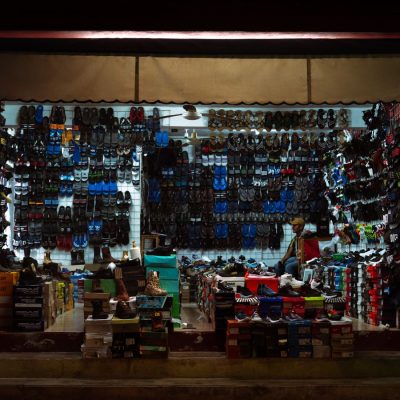
On the import side, the geography is stark: almost eight out of every ten pairs of imported footwear in Brazil now come from just three Asian countries — China, Vietnam and Indonesia. China shipped 10 million pairs (US$31 million), up 26.8% in volume. Vietnam supplied 8.3 million pairs (US$181 million), and Indonesia 4.78 million pairs (US$86.23 million). Asian supply chains are filling Brazilian closets even as Brazilian factories idle.
Context matters. According to the World Footwear 2026 Yearbook, Brazil remains home to one of the world’s largest footwear industries, producing around 848 million pairs in 2025, with exports broadly stable in value at US$958 million. The sector is overwhelmingly domestic-market oriented, which means it is uniquely exposed to import penetration when the currency, tariffs and cost structures tilt against local makers.
The policy implication is clear and urgent. A 5.6% drop in domestic production, collapsing exports to traditional partners, and a record import surge are not separate problems — they are one story about competitiveness. Whether the answer lies in tariff defence, productivity support, or a weaker real to revive exports, Brazil’s footwear cluster cannot afford to treat July’s US$3.6 million deficit as a rounding error. Three decades of surplus have just met their hardest test.
Source: World Footwear (worldfootwear.com), based on Abicalçados and Secex data, August 2026.