 中文
中文“Start on the Factory Floor” — The Advice a Second-Generation Sole Maker Wants You to Hear
The footwear industry has a succession problem it does not much like discussing. Family firms that built European component manufacturing over three or four decades are reaching the point where the founders want to step back, and the next generation frequently does not want to step forward.
So when someone does, it is worth listening to what they learned.
João Mendes graduated in Management Information Systems from the University of Coimbra and joined ISI Soles, the Portuguese manufacturer specialising in components for the footwear industry, as part of its second generation. His account of that transition is refreshingly free of the usual talk about legacy and passion.
He Chose It Knowing What It Was
Asked whether working in footwear was the natural choice, Mendes is direct: “Yes, it was. Even while I was studying for my degree, I was eager to learn more about the industry and explore it further. So, when I finished my degree, joining ISI Soles made perfect sense, even though I knew it was a demanding sector with a fast-paced work environment.”
That final clause is the honest part. Footwear component manufacturing is not a comfortable business. Margins are compressed between brand customers who negotiate hard and raw material suppliers who do not. Lead times are short and shrinking. Seasonal collections mean demand arrives in waves that must be absorbed with fixed capacity.
Someone with an information systems degree from a good Portuguese university has other options. Choosing this one with clear eyes is a different proposition from inheriting it by default.
What ISI Soles Does, and Why Range Is the Moat
Mendes defines the company’s edge in one word: diversity.
“ISI Soles stands out thanks to its ability to respond effectively to market needs, which is mainly due to the diversity of its product range. Over the years, the company has established itself as a leading manufacturer of TPU and TPR soles, while also strengthening its focus on the constantly evolving prefabricated sector.”
TPU and TPR are the workhorse materials of modern sole production — thermoplastic polyurethane offering abrasion resistance and durability, thermoplastic rubber offering flexibility and cost efficiency. A manufacturer capable of working across both, plus prefabricated components, can serve customers whose specifications shift season to season without those customers needing to change supplier.
For Portuguese footwear, which has repositioned itself over two decades from low-cost production toward higher-value, quick-turnaround manufacturing, this flexibility is not a nice-to-have. It is the entire competitive proposition. Portugal cannot beat Asia on unit cost. It wins on responsiveness, short runs and the ability to change a specification without a six-month lead time — and that only works if the component base can move at the same speed.
The Hardest Part Was the Materials
Mendes is candid about his biggest challenge, and it is not management or systems.
“On a personal level, it has been difficult to understand the complexity and diversity of the range of raw materials and how they behave. As the company offers a wide range of solutions, and I had no previous experience in this field, this learning process has been particularly demanding but also very rewarding.”
This is the recurring blind spot in industry succession planning. Businesses assume the incoming generation needs commercial and digital skills, which they usually already have. What they actually lack is material intuition — the accumulated understanding of how a compound behaves under heat, how a formulation changes with humidity, why a sole that tested perfectly in the lab delaminates in the field.
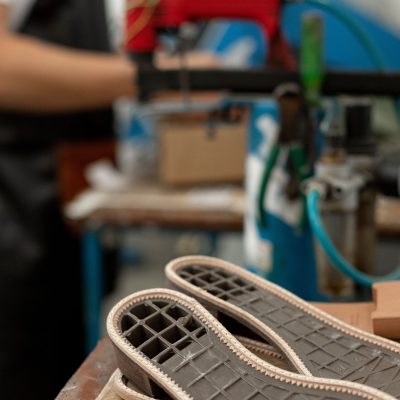
That knowledge is not written down anywhere useful. It sits in the heads of production staff who have spent thirty years watching materials fail, and it transfers only through time on the floor.
The Advice
Which brings Mendes to his recommendation for anyone entering the sector.
“The most important thing, I’d say, is to start on the factory floor. That’s where you can really understand the processes, how production works, and the dynamics of the company. After that, I’d recommend working in different departments to familiarise yourself with every stage of the process and gain an overview of the entire business. This knowledge will be essential for future growth and taking on more responsibilities.”
It is unfashionable advice. The prevailing model in family manufacturing succession is to send the next generation for an MBA, place them in commercial or strategy roles, and let them modernise from the top. That approach produces executives who can build a forecast model but cannot tell you why a batch failed.
Mendes is arguing for the opposite sequence — floor first, function-hopping second, responsibility third. It is slower. It is also how the people who built these companies learned in the first place.
Why This Matters Beyond One Company
Europe’s footwear sector faces a workforce gap running into the hundreds of thousands by 2030, and the shortage is sharpest in exactly the technical roles that require years of accumulated material knowledge.
Recruitment campaigns and training programmes help. But the fastest way to lose that expertise is for family manufacturers to hand over to a generation that never learned it — and the surest way to keep it is the unglamorous path Mendes describes.
Start on the floor. Everything else is easier afterwards.
Source: World Footwear
TL;DR
“Start on the Factory Floor” — The Advice a Second-Generation Sole Maker Wants You to Hear The footwear industry has a succession problem it does not much like discussing. Family firms that built…
Frequently Asked Questions
2?
“Start on the Factory Floor” — The Advice a Second-Generation Sole Maker Wants You to Hear The footwear industry has a succession problem it does not much like discussing.
2?
“Start on the Factory Floor” — The Advice a Second-Generation Sole Maker Wants You to Hear The footwear industry has a succession problem it does not much like discussing.
2?
“Start on the Factory Floor” — The Advice a Second-Generation Sole Maker Wants You to Hear The footwear industry has a succession problem it does not much like discussing.
2?
“Start on the Factory Floor” — The Advice a Second-Generation Sole Maker Wants You to Hear The footwear industry has a succession problem it does not much like discussing.
Key Takeaways
“Start on the Factory Floor” — The Advice a Second-Generation Sole Maker Wants You to Hear The footwear industry has a succession problem it does not much like discussing. The implications extend across the leather, tannery, and footwear value chain—signals that buyers, suppliers, and investors should track closely.
Related Articles
- Why do some genuine leather bags only sell for a few hundred yuan? The factory director reveals the truth: what you think of as “genuine leather” may be a scam
- “First-layer leather vs second-layer leather, a 20-year veteran factory manager explains it in one sentence”
- What makes the lizard-pattern leather so premium? The factory director reveals the secrets of the “evergreen style” of light luxury bags